Manicouagan
Quebec
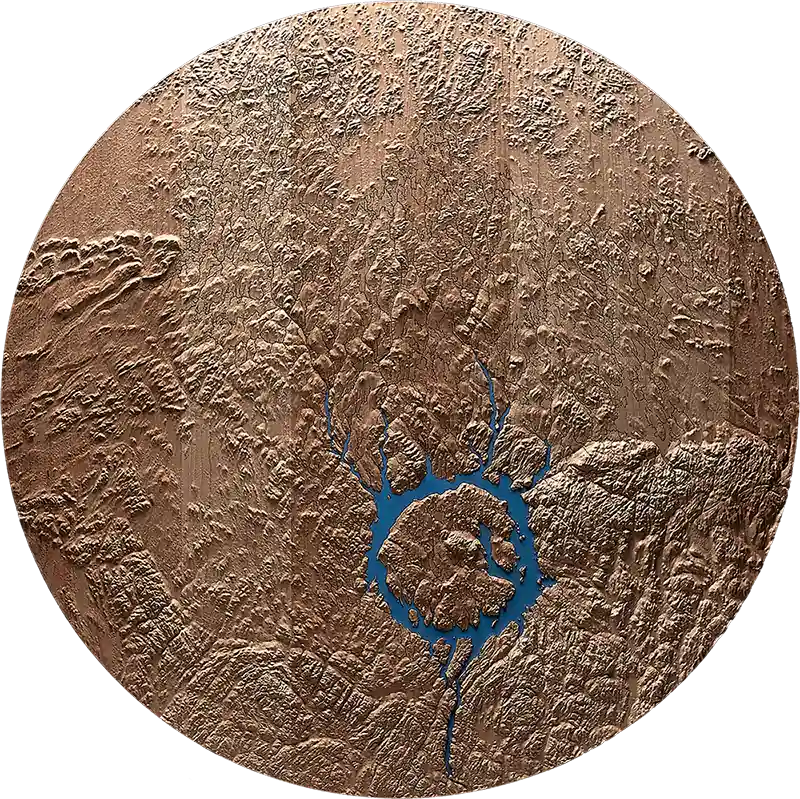
Relief of the Manicouagan watershed in Quebec, sculpted in maple with a single body of opaque resin at the reservoir.
The surface is cut to the drainage divide, and dry channels run through the terrain from the perimeter toward the center.
The resin sits level at the present water surface, holding the height of the water and nothing of the ground beneath it.
Capture
A meteorite struck here 214 million years ago and opened a crater sixty miles wide. Erosion has since worn that structure down to a ring of low ground around an uplifted central peak, and in the 1960s the Daniel-Johnson Dam raised the water until the ring filled and closed into one continuous reservoir.
The boundary that governs the place now is the drainage divide rather than the crater rim. Rain and snowmelt falling anywhere inside that line — an area larger than Massachusetts — move downhill through progressively larger channels toward the same body of water; a few yards outside it, they go somewhere else entirely.
The reservoir releases through a single river, and every season of rain and snowmelt renews the gathering.
Full circular composition
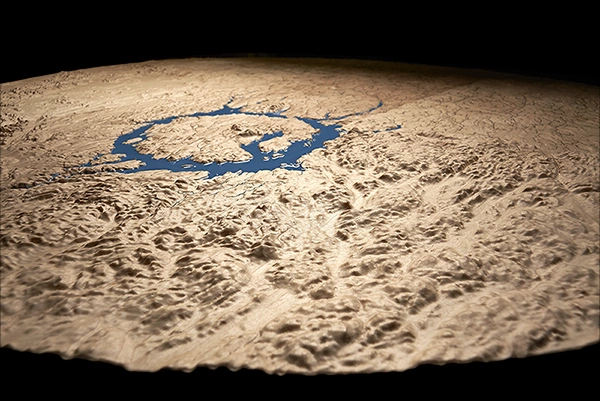
Reservoir ring around the central peak
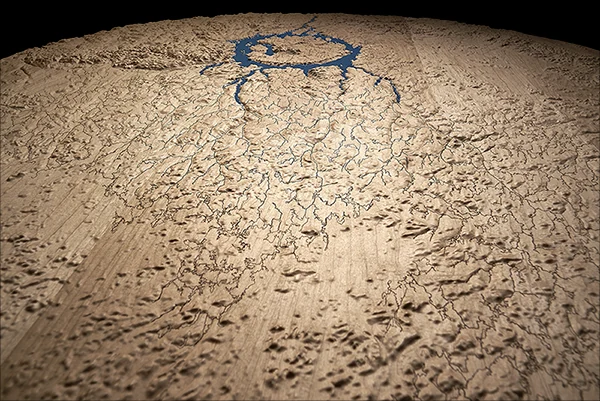
Channels gathering toward the reservoir
Available from the studio. Inquire about available work.